
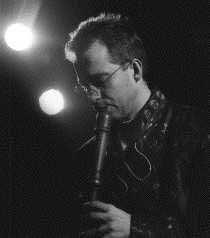
The Wandering Flute was commissioned by Rikskonserter and premiered by Dan Laurin at Stockholm New Music 1996.
As the title says the thought behind the piece is that the flute moves around the audience. It approaches from fara away and moves around and through the room.
There were six loudspeakers surrouding the audience and a midi controlled mixer console, one computer running Max. The patch was controlling one reverb and one delay for every loudspeaker. At the first performance we used six Lexicon LXP1 digital reverb units. Later for a performance in Odense, Denmark, the MaxMSP was available and all sound processing was taken care of by the patch.
The work is divided in three parts:
- Diatonic (modal) and with rythms that are evenly divided (quarter notes, eight notes, sixteen notes…)
- Free tonal with the same type of rhythms
- Free tonal with completely "elastic" rhythms using tuplets
The pitches and rhythms were created in PatchWork, a graphic programming environment for algorithmic composition, based on LISP and developed by Ircam, Paris.
The same sequences of intervals were used both for the diatonic and the free tonal melodies:
- intervals related to a central pitch (diatonic, modal)
- intervals related to the previous pitch (free tonal)
The Wandering Flute can very well be performed acoustically.
HS

Optional live electronics. For technical matters, contact the composer.